News/VLM
When a camera can explain a scene
How video analytics and vision-language models work together at a building entrance.
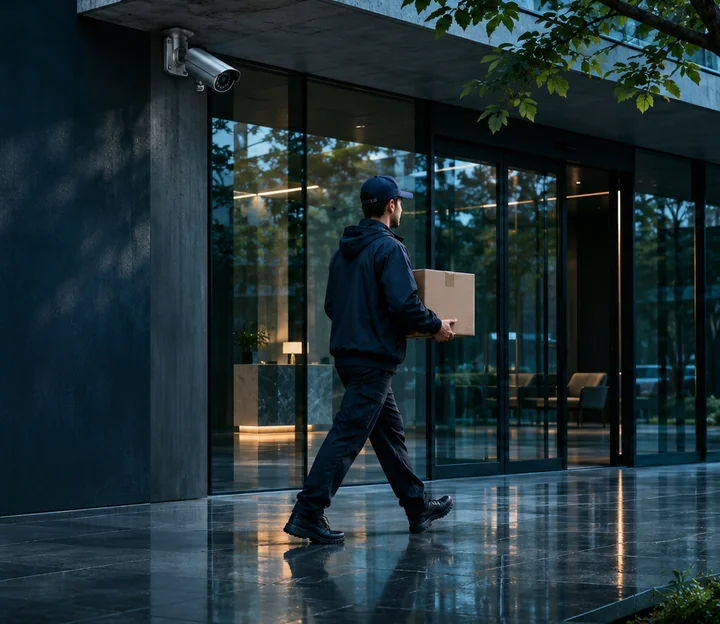
A courier approaches a door carrying a box. A minute later the courier has gone, and a box is on the ground. For a security operator those are three distinct observations. The job of analytics is to turn the recording into an event someone can check.
Define the delivery before choosing a model
A single frame may show a person carrying a package without revealing whether it is being delivered or collected. Start with an observable sequence. A person enters the area with a box, leaves the area, and the box remains on the floor. The order matters.
Draw the zone on the actual camera view. An outward-opening door might hide the floor for a moment. Footage of the open door, moving shadows and passing pedestrians matters just as much as examples of a delivery.
Give detection and tracking distinct jobs
A detector locates a person or object. A tracker connects observations across frames and can indicate when someone crosses a zone boundary. Together they can select a short interval and preserve a frame before entry, one showing the package, and one after departure.
If two people walk together, one box drawn around a person does not establish who handled the parcel. A sequence of timestamped frames leaves the operator enough evidence to review the episode.
Ask a question that the frames can answer
The vision-language model receives the selected images and a narrow question, such as “What object is visible beside the door after the person leaves?” That specifies both a location and a moment. A broad request to describe the scene can yield fluent text that never answers the operational question.
Agree on the possible outcomes in advance. For this use case they include a visible box, no object detected, and insufficient evidence. The last outcome covers an obstructed view, motion blur or a scene too dark to interpret. It can route the recording for review.
Make the result easy to verify
An event card can carry the camera name, timestamp, observed change and a link to the recording. The operator sees the before and after frames and can record why a questionable result was wrong.
Before enabling notifications, test deliveries, passers-by, collections and moments when the door blocks the view. Comparing the expected result with the actual one shows whether to change the zone, select a different frame or refine the question.